Fruit of the Spirit for Kids: Lessons and Ideas for Each Fruit
The short answer
Teach one fruit at a time, give it a kid-sized meaning and a Bible story, and look for it in everyday life. Remind children that the fruit grows as the Holy Spirit works in them, not by trying harder alone.
Galatians 5 gives one of the clearest pictures in the Bible of what a life shaped by God looks like. It is a short list children can learn by heart, and a long lesson everyone keeps learning.
But the fruit of the Spirit is love, joy, peace, patience, kindness, goodness, faith, gentleness, and self-control. Against such things there is no law.
Galatians 5:22–23 (WEB)
Nine words, one fruit. If your church Bible uses slightly different words (some say "faithfulness" for faith), use the words your children will hear on Sunday.
Start With the Tree, Not the Fruit
Before teaching the list, teach where fruit comes from. An apple tree does not strain to make apples; it grows them because it is alive and rooted. Jesus used the same picture.
I am the vine. You are the branches. He who remains in me and I in him bears much fruit, for apart from me you can do nothing.
John 15:5 (WEB)
This matters for children. The fruit of the Spirit is not a checklist for being good enough. It is what God grows in people who belong to Jesus. Children can practise it, pray for it and notice it, while knowing it is God's work in them.
Each Fruit in Kid-Sized Words
- Love: caring about others the way God cares about us. Story: the Good Samaritan (Luke 10:30–37).
- Joy: gladness in God that does not depend on getting our way. Story: Paul and Silas singing in prison (Acts 16:25).
- Peace: trusting God when things feel scary. Story: Jesus calms the storm (Mark 4:37–41).
- Patience: waiting without grumbling. Story: Abraham and Sarah waiting for Isaac (Genesis 21:1–3).
- Kindness: treating others softly and helpfully. Story: David and Mephibosheth (2 Samuel 9).
- Goodness: doing what is right, even when no one is watching. Story: Joseph refusing to do wrong (Genesis 39).
- Faith: keeping your word and sticking with God. Story: Ruth staying with Naomi (Ruth 1:16).
- Gentleness: strength that stays calm and humble. Story: Jesus welcoming the children (Mark 10:13–16).
- Self-control: saying no to what we want when it is not right. Story: Daniel and the king's food (Daniel 1:8).
Simple Ways to Practise
- Grow a paper tree. Draw a bare tree on poster paper. Each time someone spots a fruit in another person, add a paper fruit with their name and what they did.
- One fruit a week. Nine weeks covers the list. Read the story on Sunday, then look for that fruit all week.
- Ask "Which fruit did you see?" at dinner or pickup. It trains children to notice good in others.
- Pray the list. "Lord, grow patience in me today" is a prayer even a young child can pray.
- Role-play. Act out a sibling squabble or a long wait at the store, then replay it with self-control or patience.
When Kids Fall Short
They will, and so do we. Use those moments to talk about forgiveness, not to add guilt. Ephesians 4:32 reminds us to be "tender hearted, forgiving each other, just as God also in Christ forgave you." A child who learns that God forgives and keeps growing fruit in them has learned the most important part of the lesson.
A Ready Unit
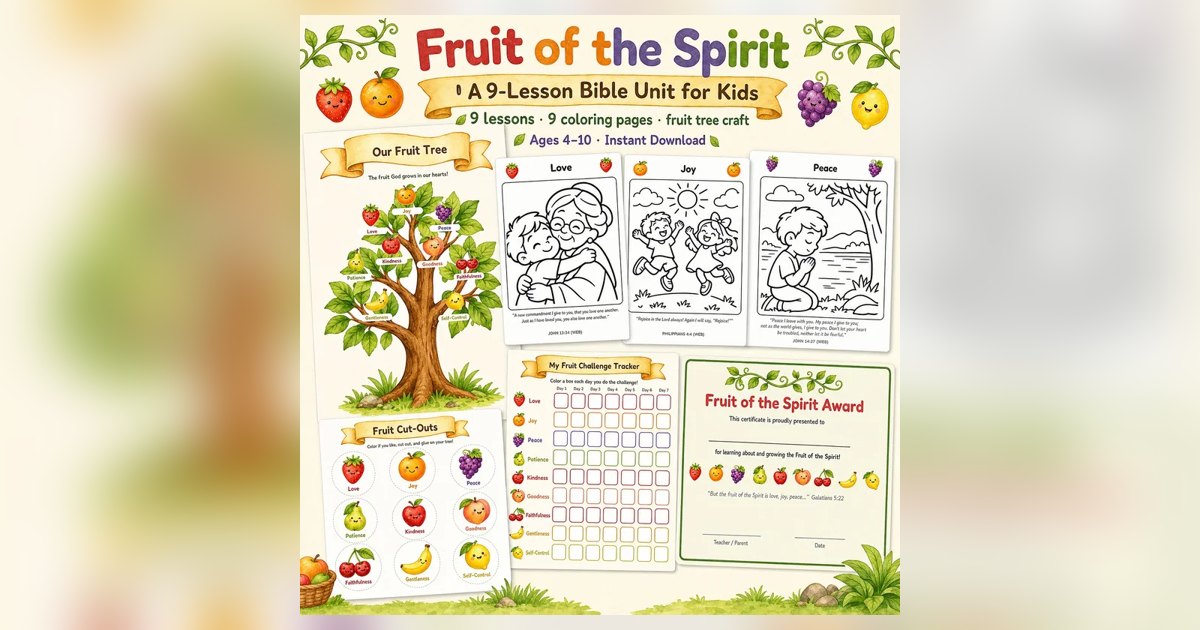
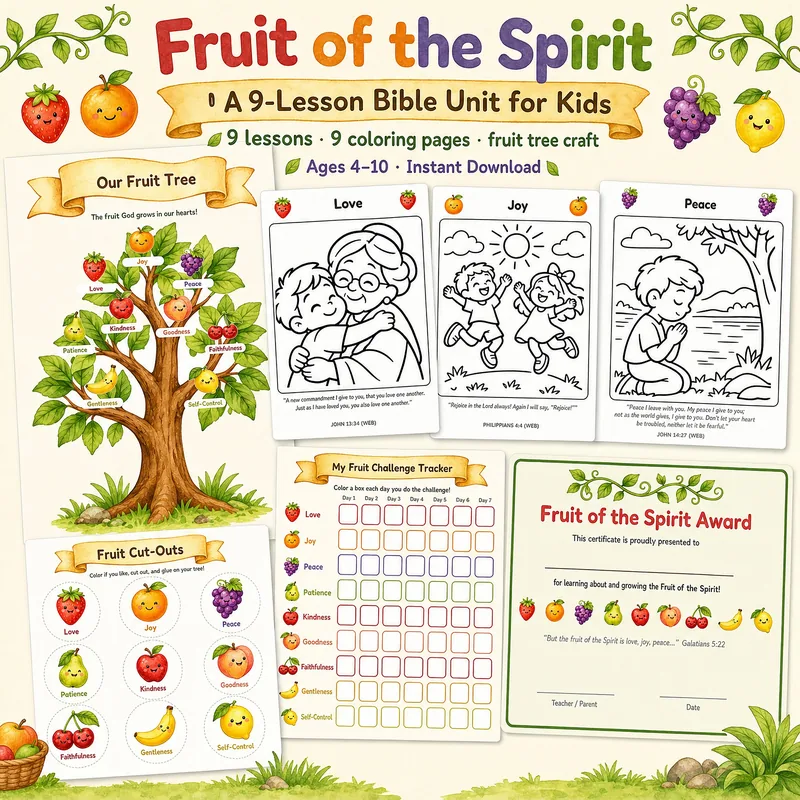
If you would like nine lessons ready to go, our Fruit of the Spirit Unit for Kids ($6) has one lesson for each fruit with a matching activity page, a fruit tree poster with cut-out fruit, a match game, a challenge tracker and an award certificate. Scripture in that unit is from the World English Bible.
Want it ready to use? Take a look at our Fruit of the Spirit Unit for Kids.
See Fruit of the Spirit Unit for Kids on EtsyTo use at home or church
Made for this post.
Sources
Scripture quotations are from the World English Bible (WEB), which is in the public domain.